






Product Highlights
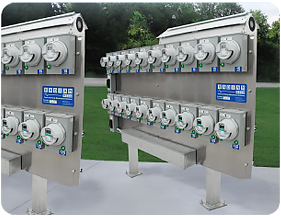
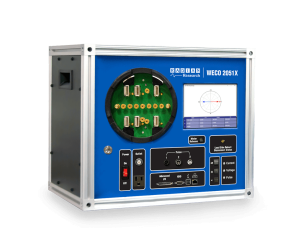
An open socket design means empty sockets have no exposed conductors and don’t affect populated sockets, so no bypass plates or blankout covers are needed. Each socket has its own resettable breaker and over-current protection, each bay has a power switch, and one emergency stop covers every bay in a cabinet.
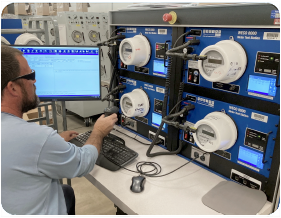
Ethernet connects the boards to a PC, and a virtual serial port lets manufacturer tools reach the meter over Ethernet for firmware updates and programming, with an optional Optocom adapter for the optical port.
Both boards are supplied with WATT-Net software for test sequencing, ANSI statistical sampling, and result storage, so functional results sit alongside your accuracy test data.

Features
- Functional testing: power-up and error check, registration on the billing system over PLC or RF, firmware programming, disconnect and reconnect, alarms, and demand, rate, and tariff settings.
- Varied test conditions: voltage dropped cycles and phase imbalance on both boards; load current, power factor, and delivered and received energy on the WECO 8030.
- 7-inch color touchscreen on each four-socket unit for local control and socket status.
- Ethernet with virtual serial-over-Ethernet for PC control and manufacturer firmware tools; optional Optocom adapter.
- Scalable: units run independently or combine into systems of up to 24 sockets.
- Safety: open socket, dead-front design, a resettable breaker and over-current protection at each socket, bay power switches, and an emergency stop.

Comprehensive Functional Testing
- Seat the meters. Empty sockets stay dead-front, with no blankout covers needed.
- Set up the test from the touchscreen or a PC: meter form and voltage, plus load current and power factor on the WECO 8030.
- Run the functional tests: communications, firmware, disconnect and reconnect, alarms, and demand and rate settings. The supplied WATT-Net software steps through the tests and stores the results.
- Move meters that pass to accuracy testing on a Test Board, such as the WECO 4050X or the multi-position WECO 8050, 8100, and 8200.
Compare the WECO 8020 and WECO 8030
Both boards share the same sockets, meter forms, voltages, safety design, touchscreen, and connectivity. The WECO 8030 adds a current source, so it can test meters under load, at a power factor of 0.5 or 1, with delivered and received energy.
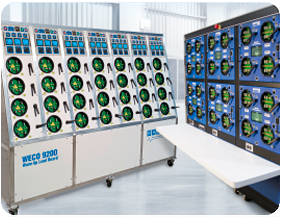
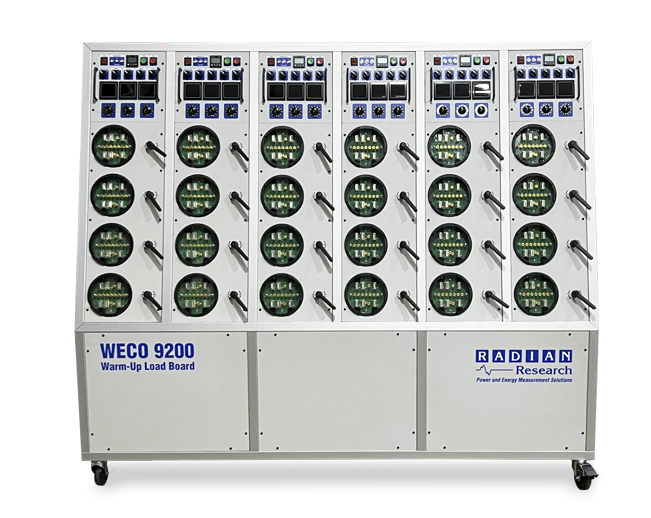
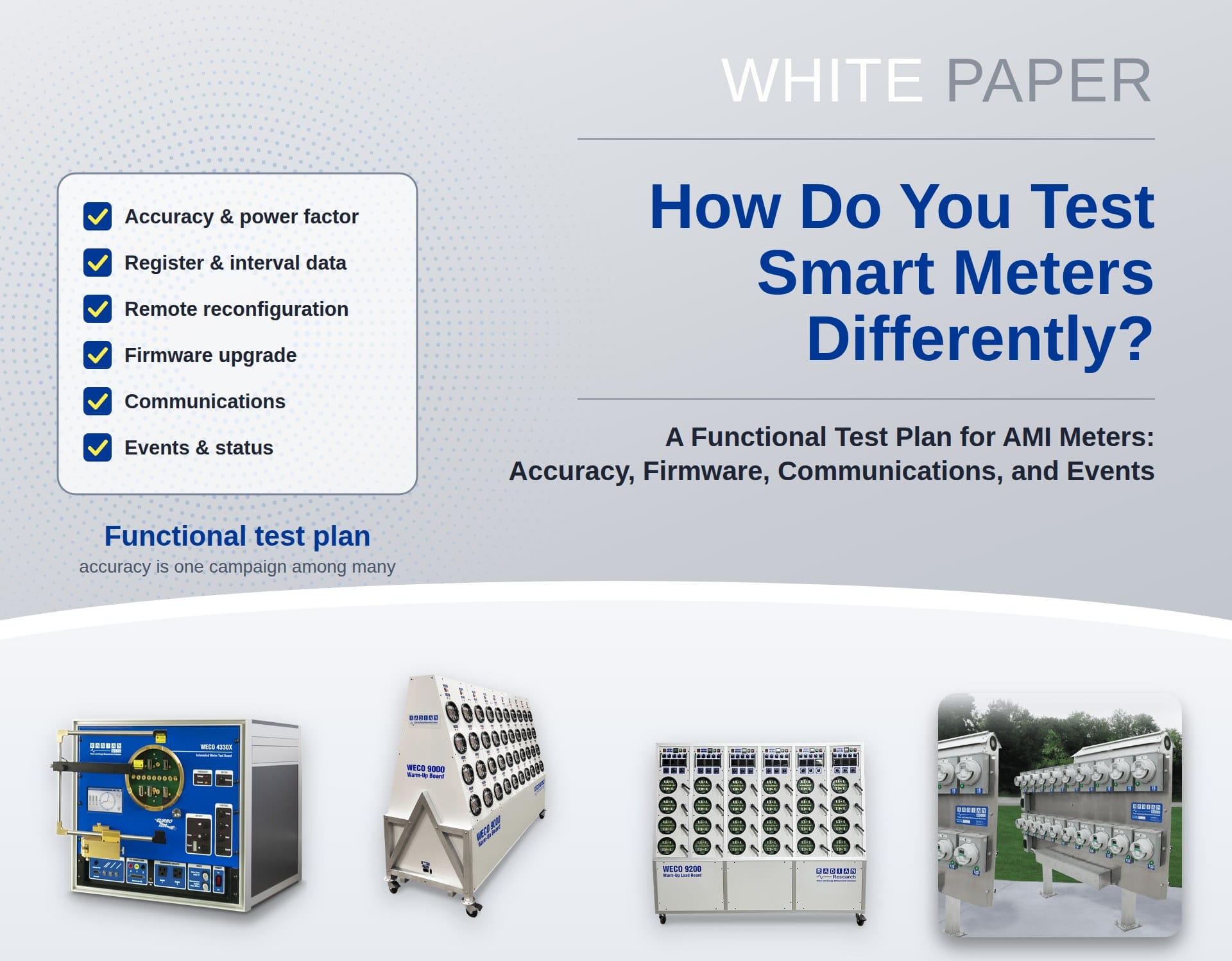
Need simpler screening? The WECO 9000 and WECO 9050 warm-up boards apply voltage for AMI functional checks, and the WECO 9200 runs meters under load over time.
| WECO 8020 | WECO 8030 | |
|---|---|---|
| Voltage | 69, 120, 138, 208, 240, 277, 347, 360, 480 V | 69, 120, 138, 208, 240, 277, 347, 360, 480 V |
| Load current | Voltage only | 0, 2.5, 5, 10, 30, or 50 A |
| Power factor | — | 0.5 and 1 |
| Energy direction | — (voltage only) | Delivered and received |
| Waveforms | Pure sine voltage; dropped cycle | Pure sine voltage and current; dropped cycle |
| Best for | Communications, firmware, disconnect, and settings checks | The same checks, plus testing under load |
Meter Qualification Board FAQ
How is a meter qualification board different from a warm-up board
Warm-up boards apply voltage (WECO 9000 and 9050) or voltage and load (WECO 9200) for basic functional checks. The WECO 8020 and 8030 go further: they test communications, program firmware, set and trigger alarms, and verify demand, rate, and tariff settings, controlled from a touchscreen or a PC, with results stored through WATT-Net.
Which meter forms and voltages are supported
Both boards support forms 1S–6S, 8S–10S, 12S–16S, 17S, 25S, 26S, 29S, 32S, 35S, 36S, 45S, 46S, 56S, 66S, 76S, 103S, 109S, 112S, 116S, 135S, 136S, 145S, and 166S, at 69, 120, 138, 208, 240, 277, 347, 360, or 480 V.
What is the difference between the WECO 8020 and WECO 8030
The WECO 8030 adds a current source: selectable load current of 0, 2.5, 5, 10, 30, or 50 A, power factor of 0.5 or 1, and delivered and received energy. The WECO 8020 supplies voltage only, so it does not test energy registration under load.
Can the boards update meter firmware
Yes. A virtual serial port lets the meter manufacturer's software reach each meter over Ethernet for firmware updates and programming. An optional Optocom adapter connects to the meter's optical port.
How many sockets can a system hold
Each unit has four sockets and measures 25 in wide by 21 in high. Units run independently or combine, two high and three wide, into a system of up to 24 sockets controlled from one PC. Both boards carry a two-year warranty.


Related Resources

Can't Find What You're Looking For?