






ANSI C12 Changes Coming in 2027: A Guide to the New Metering Standards
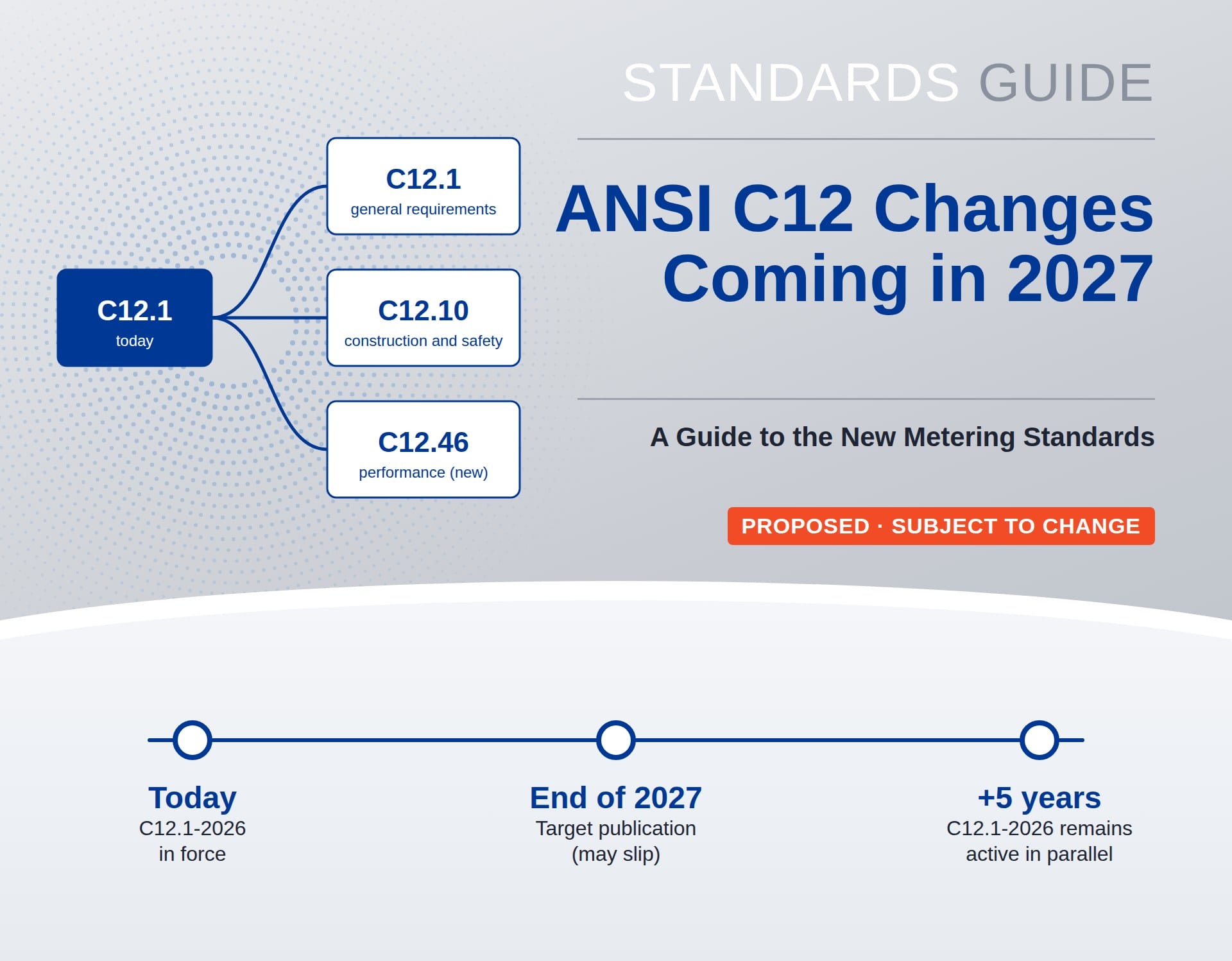
Proposed changes, subject to change. Everything in this guide describes draft standards that are still being written, balloted, and revised by the ANSI C12 committee. Nothing here is final until the standards are published. Content, standard numbers, and dates may change. ANSI C12.1-2026 remains the standard in force today.
The short answer
ANSI C12.1-2026 is the current Code for Electricity Metering, and meter shops keep testing to it. Behind it, the ANSI C12 committee is working on a proposed reorganization of the C12 family:
- C12.1 would be split into a general requirements standard, a construction and safety standard, and a new performance standard.
- New standards are proposed for reactive and apparent energy, harmonics, DC metering, and demand.
The committee’s target is publication around the end of 2027, and that date may slip. Under the current plan, C12.1-2026 would stay active for five years alongside the new C12.1. Radian Research takes part in the ANSI C12 committee work. This guide summarizes the proposals as they stand in fall 2026, and what they could mean for the meter shop.
Why the C12 standards are changing
C12.1 was written for electromechanical meters, and it grew over time to absorb requirements that used to live in C12.20. The committee aims to simplify the structure and add what a modern grid needs:
- Reactive and apparent energy, measured to a defined standard
- Harmonics: how distorted waveforms affect what a meter registers
- International alignment with OIML R46, adjusted for North American practice
- DC metering for electric vehicle charging, solar, and battery storage
- Demand metering, which has had no standard of its own for several years
C12.1-2026 today, and a proposed five-year overlap
Nothing changes now. C12.1-2026 is the active standard. The current plan is that once a restructured C12.1 is published, the two would run in parallel for five years, so utilities could choose when to make the switch.
How C12.1 is proposed to be split
| Standard | Title (proposed) | What it would cover |
|---|---|---|
| C12.1 | Electricity Metering – General Requirements | The overarching standard: controls for type testing, reference standards, and test labs, plus in-service (verification) testing |
| C12.10 | Electricity Metering – Construction and Safety | Construction, durability, and safety for AC and DC meters, including meter forms and dimensions |
| C12.46 (new) | Performance Standard for the Measurement of AC Active, Apparent and Reactive Energy | Metrology type testing of new meter designs |
| C12.2 (new) | Dictionary of Definitions, Terminology and Acronyms | One set of definitions for every C12 standard |
What would stay in C12.1: verification and re-verification
Under the proposal, the part of C12.1 that matters most to a meter shop stays in C12.1: the in-service performance requirements that utilities use to show regulatory compliance. The committee is still finalizing this section and has asked utilities for input.
- New name: in-service testing would become “verification and re-verification” testing, the terms IEC and OIML use.
- Field testing merged in: the field testing content of C12.29 would be merged into C12.1.
- ISO/IEC 17025: test lab controls would reference ISO/IEC 17025, the international standard for testing and calibration laboratories.
Proposed C12.46: reactive energy, apparent energy, and harmonics
C12.46 is a proposed new performance standard for AC active, reactive, and apparent energy.
What it would cover
- Measurement repeatability.
- Harmonics testing for all three quantities, using reworked versions of the harmonics tests that came from C12.20.
- It is derived from OIML R46.
What it would not be. As proposed, C12.46 is a type testing standard: how a manufacturer shows that a meter design measures correctly. It is not production testing, and it is not verification or re-verification testing. Utilities would still accept and test meters under C12.1.
Non-Blondel meters. The committee found that reactive energy, apparent energy, and harmonic measurements can’t be defined consistently for non-Blondel meters, because those meters don’t have a complete measuring element for every phase. The current draft therefore allows non-Blondel meters to be type approved for active energy (watthours) only.
Two related documents cover the math behind all this:
- C12.31 is currently a NEMA technical report and is planned to become an ANSI standard. It gives rigorous definitions of voltage, current, power, energy, and power factor for all waveforms.
- C12.24 is a technical report that compiles the historical VA and VAR equations.
Proposed C12.10: construction, durability, and safety
The revised C12.10 would take over the construction and safety requirements from C12.1 and OIML R46 (shock, vibration, transport drop, and temperature and humidity extremes), and reference UL 2735 for electrical safety. Proposed additions include:
- Durability: stress testing designed to show a meter will last a stated period with a stated confidence
- AC and DC meters, with construction allowances for other meter types
- New meter style and forms: the L Base meter style, and the new multi-port forms 42S and 43S. Existing dimensional data and forms, including K Base, would stay.
- A new 2D barcode that could carry the full nameplate, communication IDs, and manufacturing details, for life-cycle management. The existing barcode would stay.
- Non-Blondel forms deprecated: they would move to an annex marked “not recommended for new installations.” They could still be used.
Proposed demand standard: C12.35
C12.35 is a proposed new demand metering standard.
- It would define block and sliding-window demand.
- It would deprecate thermal demand.
- It would also govern time: how closely a meter’s clock must track real, or network, time. That matters to anyone testing demand, load profile, and time-of-use.
- It is designed so that load profile and time-of-use standards could follow.
DC metering: C12.32 and C12.33
- C12.32 covers DC energy meters, and an update is in progress to align it with C12.46.
- C12.33 is a proposed new standard for DC transducers for voltage and current.
- Together, they would cover type testing of DC meters, transducers, or combinations of both, for EV charging, solar, and storage.
Other standards to watch
- C12.19 (end device data tables): minor corrections and updates in progress
- C12.30 (meters with service switches): a proposed reduction in open/close stress cycles
- C12.34A TR: a proposed North American companion profile for DLMS/COSEM, the IEC data exchange standards, which would be adopted verbatim
- C12.36 (protection of metrological properties): meter security. The working group has not yet met.
- Open issues under discussion:
- Heat rise: can testing be made repeatable, and is a “standard socket” needed?
- Whether meter socket adapters make meters run hot.
The proposed timeline
These are the committee’s targets, not commitments. The committee notes the coordinated release may slip.
| Milestone | Target |
|---|---|
| Current C12.1 | C12.1-2026, active now |
| Most new and revised drafts editorially complete | 2026 |
| Balloted and accepted | 2027 |
| Coordinated publication of C12.1, C12.10, C12.46, and C12.32 | Around the end of 2027 (may slip) |
| C12.1-2026 remains active | Five years after the new C12.1 is published |
What it could mean for the meter shop
Nothing needs to change today. These are points to plan around as the drafts move toward publication.
- Keep testing to C12.1-2026. It is the standard in force, and under the current plan it stays active for five years after a new C12.1 is published. Our white paper, ANSI C12.1-2026 Compliance Testing, covers what it asks of the meter shop.
- Expect new terms. If the proposal holds, in-service testing becomes verification and re-verification. If you manage sample and periodic testing programs in the WATT-Net Sample and Periodic Testing module, the work itself stays the same.
- Plan for distorted waveforms. Harmonics and reactive and apparent energy are moving toward the center of the standards. Test equipment should hold its accuracy on non-sinusoidal waveforms, and it should still be at least four times more accurate than the meters it tests. Our white paper, How Accurate Does Meter Test Equipment Need to Be?, covers that ratio.
- Keep an eye on non-Blondel meters in long-term purchasing plans. They are not being banned. The draft marks them “not recommended for new installations.”
- Watch for the new forms and the 2D barcode if they are adopted in the final C12.10. WATT-Net software already supports 2D barcodes.
- Take part. The C12 committee has asked utilities for input, especially on the verification and re-verification section, which affects how utilities show compliance to their commissions.
We will update this guide as the drafts are balloted and published.
Frequently Asked Questions
Is ANSI C12.1-2026 still the standard to test to?
Yes. C12.1-2026 is the current edition and the standard in force. The changes in this guide are proposals. Under the current plan, C12.1-2026 would stay active for five years after a restructured C12.1 is published.
Are these changes final?
No. They are draft standards still being written and balloted by the ANSI C12 committee. Content, standard numbers, and dates may change before publication.
What is ANSI C12.46?
A proposed new performance standard for type testing AC meters for active, reactive, and apparent energy, including harmonics. It is derived from OIML R46 and adjusted for North America.
Would C12.46 replace meter shop testing?
No. As proposed, C12.46 is for type testing new meter designs. Verification and re-verification testing, what’s now called in-service testing, would stay in C12.1.
Can utilities still install non-Blondel meters?
Yes. Under the current draft, non-Blondel forms would be deprecated, meaning “not recommended for new installations,” and could be type approved for active energy only.
When will the new C12 standards be published?
The committee is targeting a coordinated release around the end of 2027, and notes the date may slip.