






ANSI C12.1 – 2026 Compliance Testing

ANSI C12.1-2026 Compliance Testing with the WECO 4050X Automated Test Board
In 2026, the American National Standards Institute (ANSI) published the latest revision of ANSI C12.1, Electric Meters — Code for Electricity Metering. This standard — with roots reaching back to 1910 — remains the definitive benchmark for how alternating-current watthour meters, demand meters, and related devices must perform, both when they are new and throughout their service life.
This white paper explains what ANSI C12.1-2026 covers, what it asks of the utility meter shop, and how the WECO 4050X Automated Test Board — with a RADIAN RX Xytronic reference standard at its core — gives shops a single-position test platform built to satisfy the ANSI standard’s accuracy, traceability, and record-keeping demands.
Executive Summary
In 2026, the American National Standards Institute (ANSI) published the latest revision of ANSI C12.1, Electric Meters — Code for Electricity Metering. This standard — with roots reaching back to 1910 — remains the definitive benchmark for how alternating-current watthour meters, demand meters, and related devices must perform, both when they are new and throughout their service life.
For utility meter shops, the standard is more than a reference document. State utility commissions across the country write C12.1 directly into their metering regulations, which means the accuracy tests a shop runs, the equipment it uses, and the records it keeps all trace back to this code. When the code changes, the shop’s obligations can change with it.
This white paper explains what ANSI C12.1-2026 covers, what it asks of the utility meter shop, and how the WECO 4050X Automated Test Board — with a RADIAN RX Xytronic reference standard at its core — gives shops a single-position test platform built to satisfy the ANSI standard’s accuracy, traceability, and record-keeping demands..
1. A Century-Old Code, Newly Revised
ANSI C12.1 establishes acceptable performance criteria for new types of AC watthour meters, demand meters, demand registers, pulse devices, and auxiliary devices. Just as important for the utility, it establishes acceptable in-service performance levels for the meters and devices used in revenue metering. The standard is developed and published under the auspices of the National Electrical Manufacturers Association (NEMA), and its lineage stretches back more than 110 years to the first edition in 1910.
Two recent editions matter to today’s meter shop:
The 2022 edition merged the content of ANSI C12.20 — the standard that previously governed 0.1, 0.2, and 0.5 accuracy class meters — into C12.1, creating a single unified code covering both Blondel and non-Blondel meters. The separate C12.20 standard was eliminated entirely. The 2022 edition also mandated polyphase loading for type testing of
polyphase meters and deprecated a number of
electromechanical-only tests.
The 2026 edition refines the testing procedures themselves. Key changes include:
· Corrected testing procedures for temperature and humidity effects, now permitting both single-phase and polyphase loading
· Simplified voltage tests for meters with wide input voltage ranges
· Modernized tests for high-voltage line surges, external magnetic fields, and radio frequency interference (RFI)
· Updated electrostatic discharge (ESD) testing procedures
· Retention of the harmonic influence tests originally developed for ANSI C12.20
· Modernized appendices covering measurement concepts
None of these revisions retroactively invalidates a shop’s existing test equipment. What they do is raise the bar on what a compliant test setup must be able to do going forward — particularly around flexible single-phase/polyphase loading and harmonic waveform generation. A shop’s real question isn’t “does the 2026 edition force a purchase?” but “can my current bench actually produce the test conditions the revised procedures call for?”
Where requirements differ, ANSI C12.1-2026 takes precedence over ANSI C12.10, which addresses the physical aspects of watthour meters.
The direction of travel is clear: the code keeps pace with a meter population that is now overwhelmingly solid-state and increasingly communicating. With roughly 119 million smart metering installations deployed by U.S. utilities as of 2022, the accuracy and reliability expectations placed on revenue meters — and on the shops that test them — have never been higher.
2. What the Standard Asks of the Meter Shop
ANSI C12.1 divides responsibility between the meter manufacturer and the utility. Type testing of new meter designs — environmental chamber work; surge, ESD, and RFI testing; mechanical shock and vibration — largely belongs to the manufacturer. The utility meter shop’s obligations center on three areas.
2.1 Acceptance Testing of New Meters
Before new meters enter revenue service, the utility verifies that they perform within the accuracy limits of their class. This means testing meter registration at the standard test points — full load, light load, and power factor — and confirming performance falls inside the acceptable limits the code defines. Many utilities test every incoming meter; others use the statistical sampling methods the code describes, evaluating lots by the method of attributes or the method of variables.
2.2 In-Service Performance Testing
Meters drift, age, and encounter conditions no acceptance test anticipated. C12.1 establishes in-service performance levels and describes the test programs — periodic interval testing, variable interval plans, and statistical sampling plans — that utilities use to demonstrate their installed meter population still measures accurately. State commissions typically adopt one or more of these programs into their rules, and the shop’s test data becomes the utility’s evidence of compliance.
2.3 Traceable Standards and Sound Test Practice
Section 3 of the code addresses the standards and standardizing equipment behind every test. A meter test is only as good as the reference standard it compares against, and that standard must be traceable to the national standards maintained by the National Institute of Standards and Technology (NIST). The code also expects the test setup itself — the socket connections, the applied voltages and currents, the waveform quality — to support a valid comparison. A dirty socket jaw or an unstable current source doesn’t just slow the shop down; it corrupts the evidence the utility depends on.
The practical takeaway for the shop manager: compliance is not a single test but a system — accurate sources, traceable standards, repeatable procedures, and defensible records.
3. The WECO 4050X: A Test Platform Built Around the Code
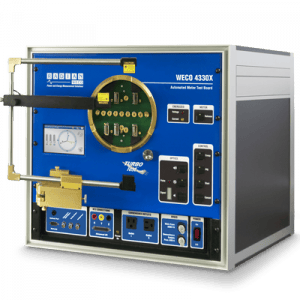
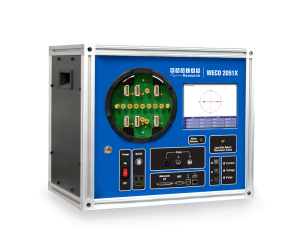
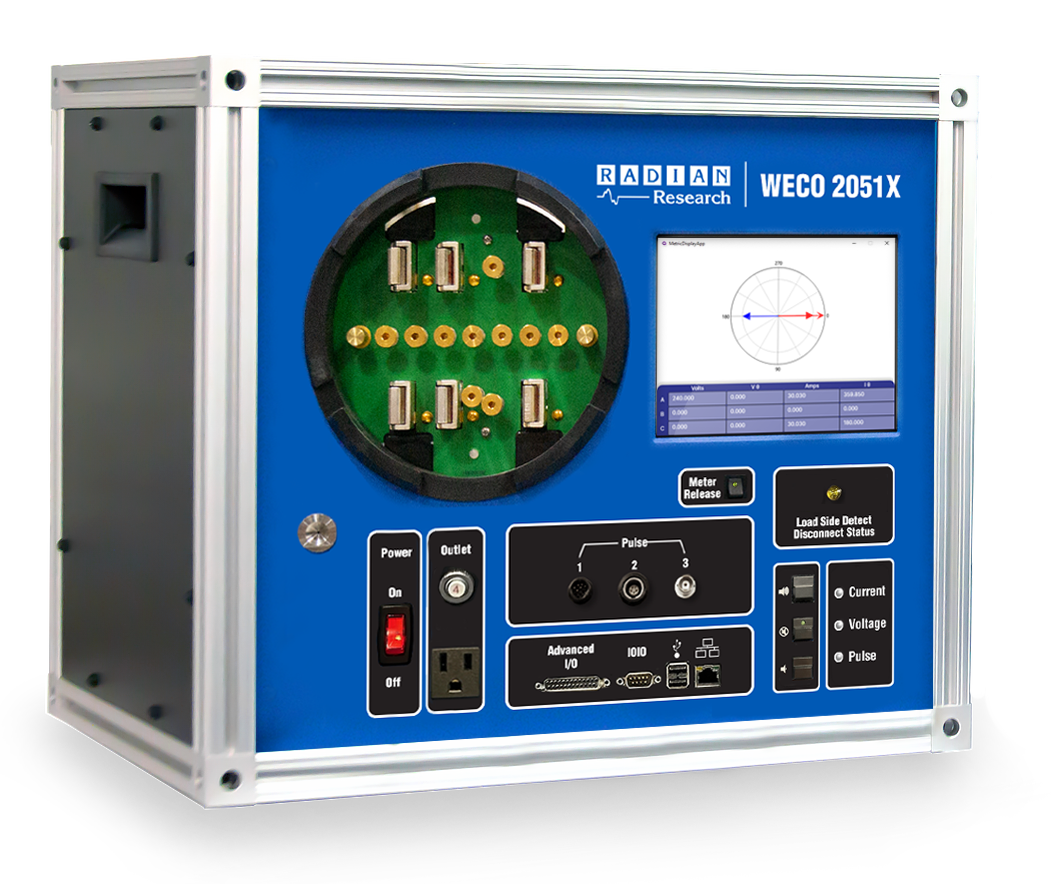
The WECO 4050X is the single-position member of RADIAN’s WECO 4000X Series of automated watthour meter Test Boards. It is the most compact system in the series, designed for shops that test single-phase and polyphase meters and want laboratory-grade measurement in a bench-scale footprint. Every element of the platform maps to a compliance need.
3.1 A True Reference Standard Inside — Not a Metering Chip
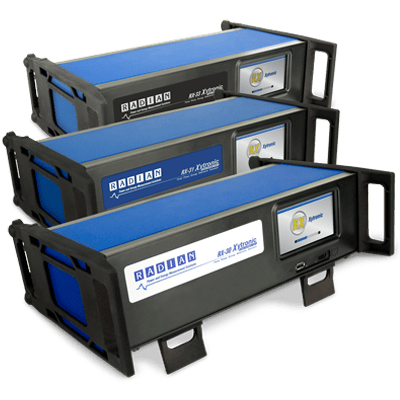
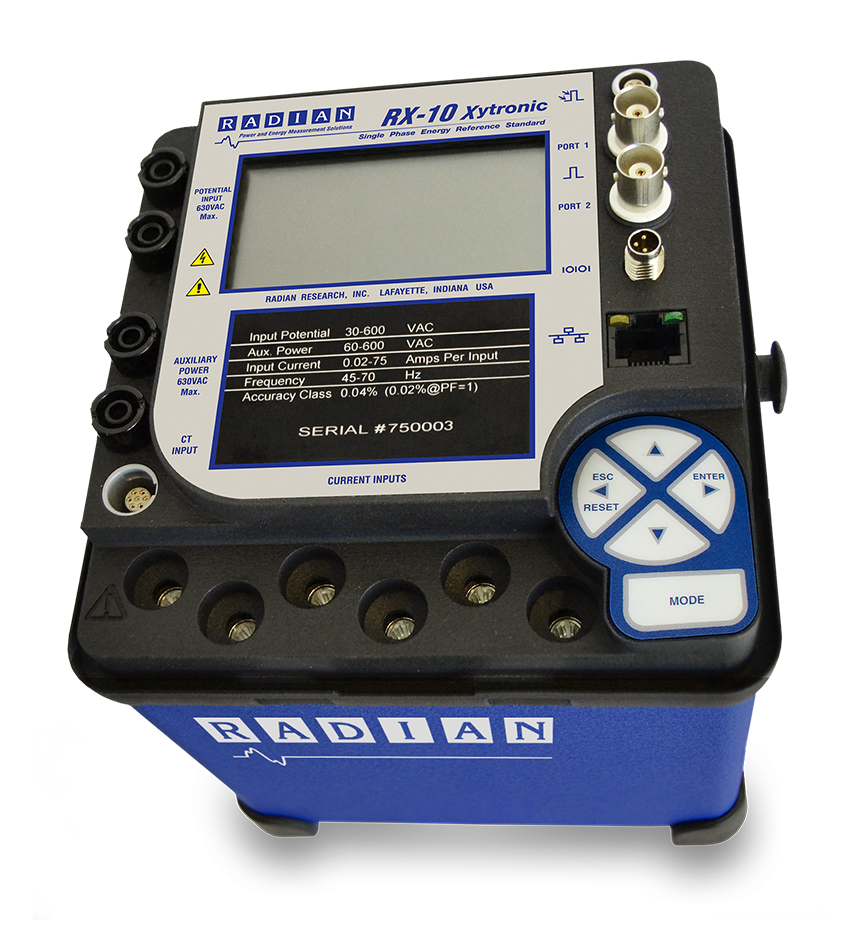
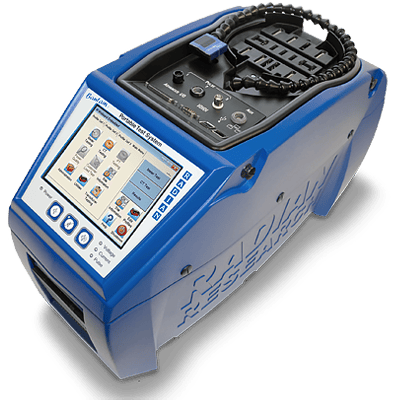
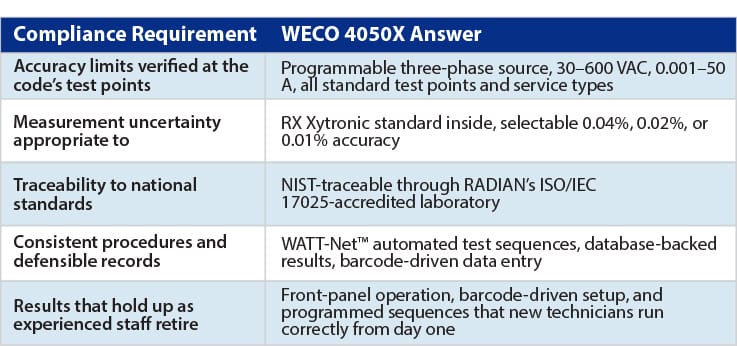
Some test systems derive their reference measurement from the same class of metering chip found in the meters under test. The WECO 4050X takes a different approach. At its heart is a RADIAN RX Xytronic three-phase reference standard — the same measurement engine trusted across the industry, drawing on the legacy of RADIAN’s RM (Metronic) and RD (Dytronic) reference standards. The RX is available in three accuracy tiers: the RADIAN RX-30 (0.04%), RX-31 (0.02%), and RX-33 (0.01%), letting the shop match measurement uncertainty to the accuracy classes it tests, including the demanding 0.1 and 0.2 class meters that C12.1 absorbed from C12.20.
The RX standard performs fully autoranging, simultaneous four-quadrant measurement across a dynamic range of 30 to 600 VAC and 1 mA to 200 A, using RADIAN’s purpose-built integrating A/D signal conversion. Because the converter was designed specifically for power and energy measurement, it excels at the distorted, non-sinusoidal waveforms that the code’s harmonic influence tests are built around.
Every RADIAN reference standard is traceable to NIST through RADIAN’s own accredited metrology laboratory in Lafayette, Indiana — the traceability chain Section 3 of the code requires, documented and defensible.
3.2 Test Sources That Match the Standard’s Test Points
The WECO 4050X generates true three-phase test voltage from 30 to 600 VAC and test current from 0.001 to 50 amps, with independently programmable voltages, currents, and phase angles.
That range covers the full-load, light-load, and power-factor test points for self-contained residential and commercial meters, and the programmability lets the shop simulate the line conditions — service types, unbalanced loading, shifted phase angles — that the code’s test procedures call for. The 2026 edition’s allowance for both single-phase and polyphase loading in several tests is exactly the kind of flexibility a programmable three-phase source is built to exploit.
For harmonic influence testing, the WECO 4000X Series platform provides harmonic generation to the 50th harmonic with independent control in each of the six voltage and current channels, supporting the waveform-distortion test conditions retained in the 2026 edition.
3.3 The Smart Socket: Protecting the Integrity of Every Test
The WECO 4050X Smart Socket accepts all S-base ANSI meter forms, with optional adapters for A-base, K-base, and IEC meters. Its zero-insertion-force design reduces operator fatigue while high-conduction silver and gold contact surfaces minimize the contact impedance that quietly degrades test accuracy. A dedicated microcontroller senses meter presence, clamps the meter automatically, and enforces safety interlocks — the meter cannot be released while voltage or current is applied, and the true dead-front design keeps operators away from live parts.
This matters for compliance because contact contamination creates a voltage drop at the meter that the reference standard never sees. The result is a meter that appears inaccurate when the test setup is actually at fault — a failure mode the code’s emphasis on sound standardizing equipment is meant to prevent.
3.4 Testing Every Meter Technology in the Population
Most utilities still carry a mixed population. The WECO 4050X tests solid-state meters through its optical pickups, pulse inputs, and KYZ contact connections, and tests electromechanical meters with a solid-state laser optics arm supporting both through-the-hole and reflect-mode disk sensing. Creep and no-load tests — among the code’s basic accuracy tests — run from dedicated front-panel functions.
3.5 Automation and Records with WATT-Net
ANSI C12.1 compliance programs live or die on records: test plans, as-found and as-left results, sample selections, and performance histories. WATT-Net software — included with every WECO Test Board — programs test sequences to the shop’s C12.1-based procedures, runs them consistently across operators, and captures results into a managed database compatible with major database platforms. Barcode scanning enters meter data automatically from the barcode on the meter nameplate, eliminating transcription errors, and test results flow directly into the reporting a statistical sampling or periodic testing program requires.
Automation is a compliance feature, not just a convenience. A programmed test sequence executes the same test points, the same limits, and the same documentation every time — which is precisely what an auditor or commission staff member wants to see.
3.6 Built for the Realities of the Shop Floor
A compliance program only works if the equipment behind it shows up every day. The WECO 4050X is engineered for uptime: fuseless self-protection technology guards the voltage and current sources against wiring faults, and a modular card-cage design with clearly labeled circuit boards keeps troubleshooting and service fast. RADIAN backs every instrument with a two-year warranty and factory support from Lafayette, Indiana — engineers who understand metrology, not a call center.
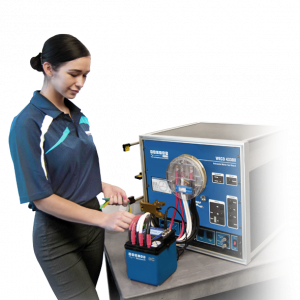
The system is also built for a workforce in transition. Once an engineer or supervisor sets the test parameters, technicians run complete tests from the front panel — Creep, Jog, Start, and Cancel — without touching the computer. Barcode-driven setup means a new technician scans the meter, presses Start, and produces the same defensible result a twenty-year veteran would. In a shop losing experienced staff to retirement, that consistency is worth as much as the accuracy specification.
4. Working Backward from the Compliance Goal
A useful way to evaluate any test platform is to start from the end state a shop manager must be able to demonstrate:
“Every revenue meter we deploy and maintain measures within the limits of
ANSI C12.1, and we can prove it.”
Working backward from that goal, five requirements emerge, and the WECO 4050X answers each one:
5. Conclusion
ANSI C12.1-2026 continues a century-long pattern: as metering technology advances, the code tightens and modernizes the performance evidence utilities must produce. The revisions do not change the fundamental job of the meter shop, but they do reward shops whose equipment can generate the code’s test conditions faithfully, measure against a traceable standard with margin to spare, and document every result automatically.
The WECO 4050X was built for exactly that job — a compact, automated, single-position test system with a laboratory-grade reference standard inside and a data management environment around it.
The best way to evaluate a Test Board is on your own bench, with your own meters and your own technicians. To arrange a demonstration or discuss how the WECO 4050X fits your shop’s compliance program, contact RADIAN at (765) 449-5500 or visit www.radianresearch.com.
About Radian Research
Radian Research, Inc., headquartered in Lafayette, Indiana, is a 100% employee-owned company that has manufactured precision electricity measurement and test equipment for electric utilities, meter shops, and calibration laboratories for more than 35 years. Over 300
million meters produced in the past 30 years are referenced to a RADIAN standard. RADIAN’s instruments are traceable to NIST through the company’s own ISO/IEC 17025-accredited metrology laboratory.
To learn more about the WECO 4050X Automated Test Board, visit our website.